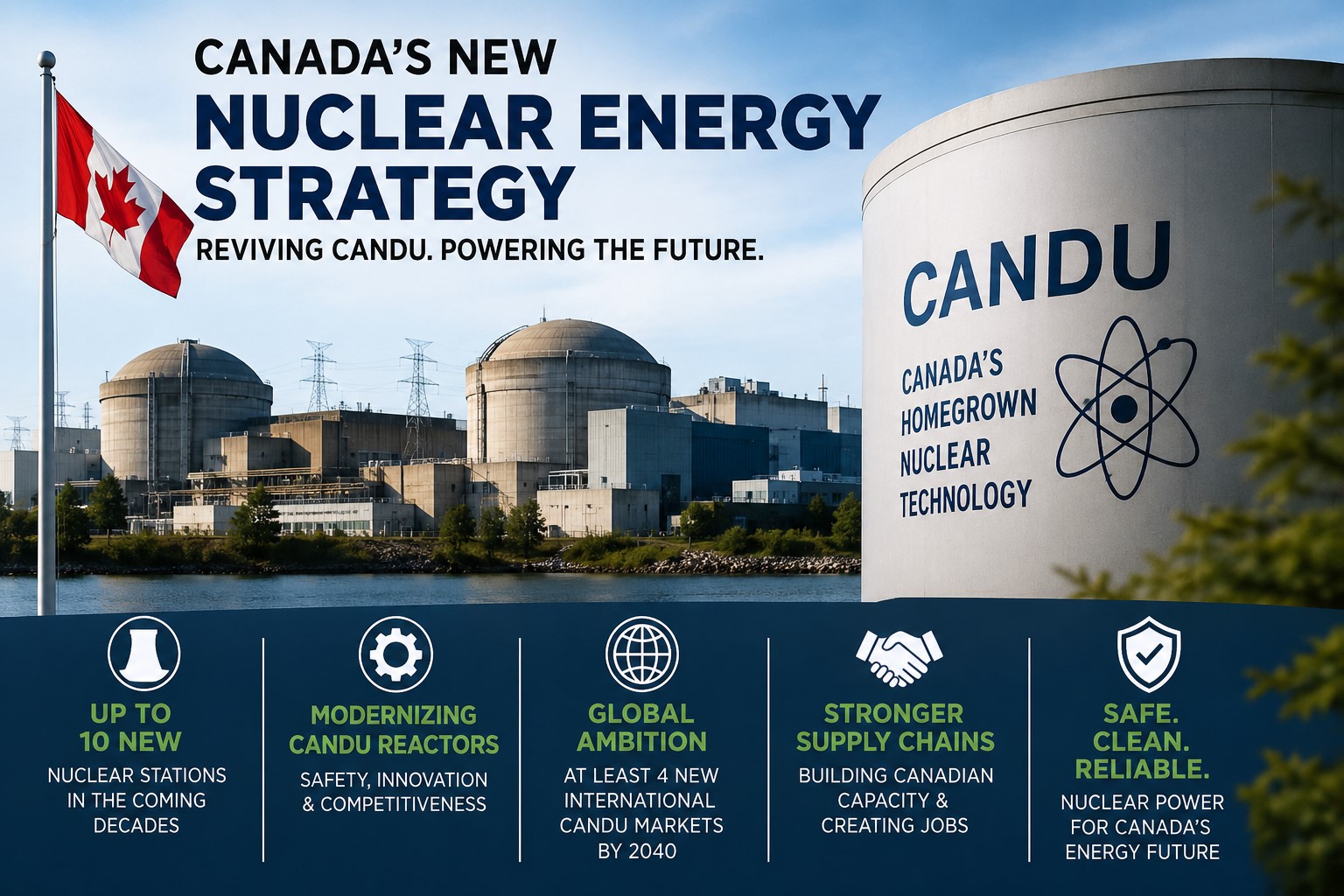
Canada’s Nuclear Energy Strategy Revives Focus on CANDU Reactors
Canada’s federal government has launched a new Nuclear Energy Strategy aimed at strengthening the country’s nuclear sector, modernizing homegrown CANDU reactor technology, and expanding Canada’s international nuclear footprint.
The strategy positions nuclear power as a central part of Canada’s future energy mix as electricity demand rises and countries increasingly turn to low-emission energy sources.
A key objective is to support the development of up to 10 new nuclear generating stations over the coming decades while reinforcing domestic supply chains tied to CANDU technology — Canada’s reactor design that has powered nuclear facilities since the 1960s.
At the same time, Ottawa emphasized that provinces will retain the authority to select reactor technologies for future projects. Alongside CANDU, the strategy references alternatives including Westinghouse Electric’s AP1000 and GE Vernova Hitachi’s BWRX-300.
Despite this flexibility, CANDU receives major attention throughout the plan. The government pledged to improve the reactor’s commercial competitiveness, explore domestic production of heavy water used in CANDU systems, and target entry into at least four new international CANDU markets by 2040.
Energy Minister Tim Hodgson said future reactor development must incorporate updated safety requirements introduced after the 2011 Fukushima nuclear accident while continuing broader modernization efforts.
The original CANDU program was developed through Atomic Energy of Canada Limited before reactor operations were transferred to AtkinsRéalis in 2011. Although newer reactor concepts were proposed over the years, none reached commercial deployment.
To address that gap, AtkinsRéalis has been developing an updated reactor design known as the CANDU Monark. Preliminary engineering work is expected to progress through the decade, while Ottawa’s strategy sets a goal of delivering a cost-competitive CANDU design by 2030.
Industry reaction has been mixed. Supporters argue the strategy provides long-term policy certainty and strengthens Canada’s position in global nuclear markets. Critics, however, warn against favouring one reactor technology and argue regulatory reform and faster approvals may matter more than government backing.
Ontario has also signaled support for expanding nuclear generation but called for direct federal investment to help advance CANDU Monark development for future projects.
Political leaders offered differing views. Conservatives questioned whether the strategy would move beyond announcements into execution, while the NDP argued that renewable technologies such as solar, wind, and battery storage remain faster and more cost-effective options.
The strategy does not commit major new funding but marks one of Ottawa’s strongest endorsements of nuclear energy in decades, signaling a renewed effort to position Canada as a global player in the next generation of nuclear power.



Comments (0)
Sign in to join the conversation.