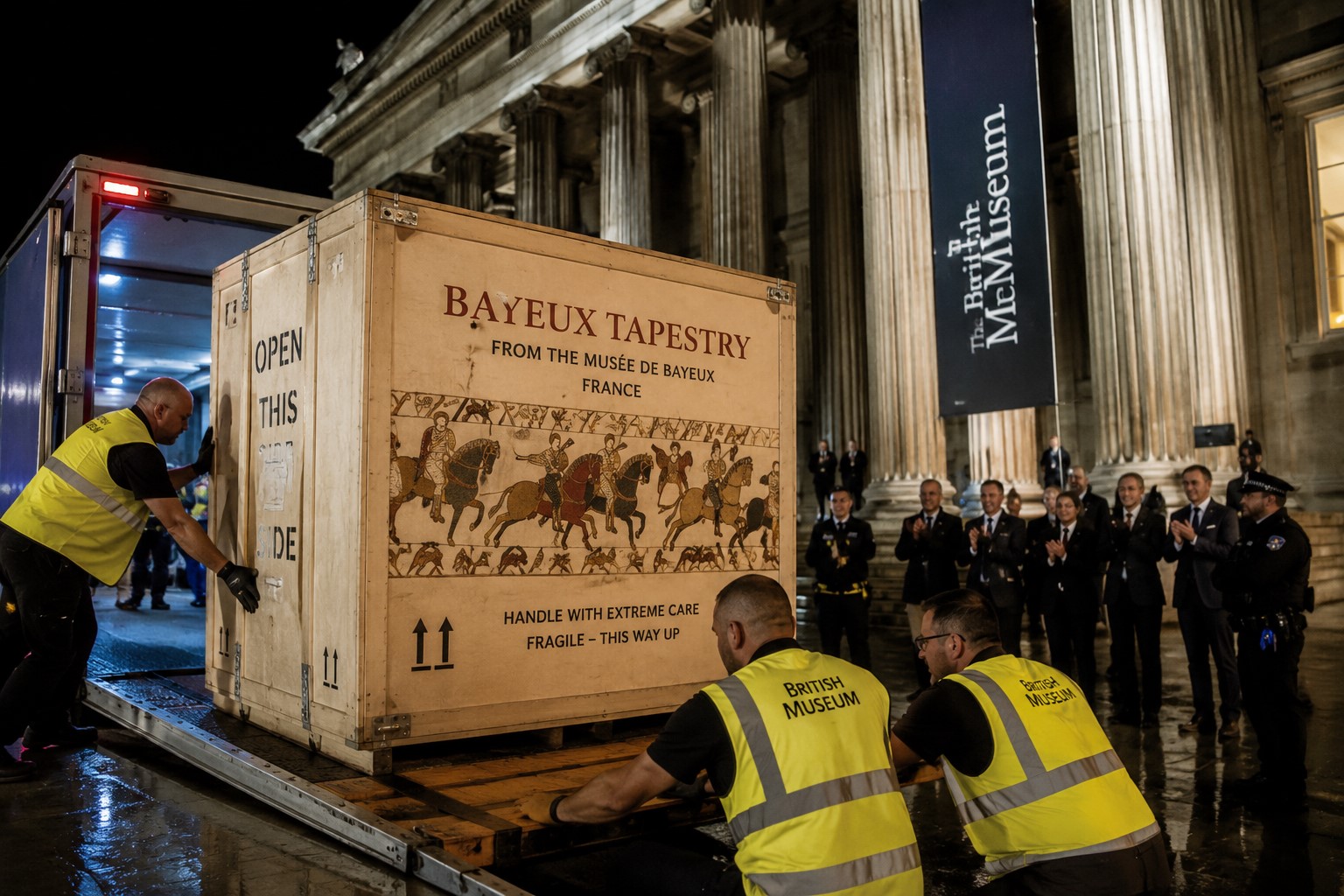
The world-famous Bayeux Tapestry has arrived at the British Museum following a carefully planned overnight transport operation from France, marking the first time in nearly 1,000 years that the historic masterpiece will be displayed in Britain.
Transported under strict security, the priceless medieval artwork was packed inside a climate-controlled, shock-resistant container before making the journey across the English Channel. After an 11-hour trip under police escort, the tapestry was delivered safely to the British Museum, where museum staff and officials welcomed its arrival.
The 70-metre-long embroidered masterpiece will go on public display from September 10, 2026, until July 2027. Museum officials expect it to become one of the institution's most visited exhibitions, with demand already exceptionally high after thousands of tickets were sold shortly after release.
British Museum Director Nicholas Cullinan described the arrival as a landmark cultural event, saying it represents a unique opportunity for visitors to experience one of the most significant works of medieval European history.
Created in the 11th century, the Bayeux Tapestry depicts the events leading to the Battle of Hastings in 1066, including William the Conqueror's invasion of England. Stretching approximately 70 metres, it features hundreds of embroidered human figures, animals and battle scenes that chronicle one of the most important moments in British history.
The loan forms part of a cultural exchange agreement between France and the United Kingdom. In return, the British Museum will lend important Anglo-Saxon treasures, including items from the Sutton Hoo collection, to museums in Normandy while the Bayeux Museum undergoes renovation.
Museum experts said the tapestry will spend several days acclimatising before it is carefully unpacked and installed for public display. Specialists have emphasised that extensive conservation planning and multiple trial transport runs were carried out to ensure the artwork's safe arrival.
Despite concerns from some French cultural figures about moving the fragile embroidery, officials insist every precaution was taken to protect the nearly 1,000-year-old masterpiece throughout its journey.
The exhibition is expected to be one of the biggest cultural attractions in the UK over the coming year, highlighting the shared historical heritage between Britain and France.



Comments (0)
Sign in to join the conversation.