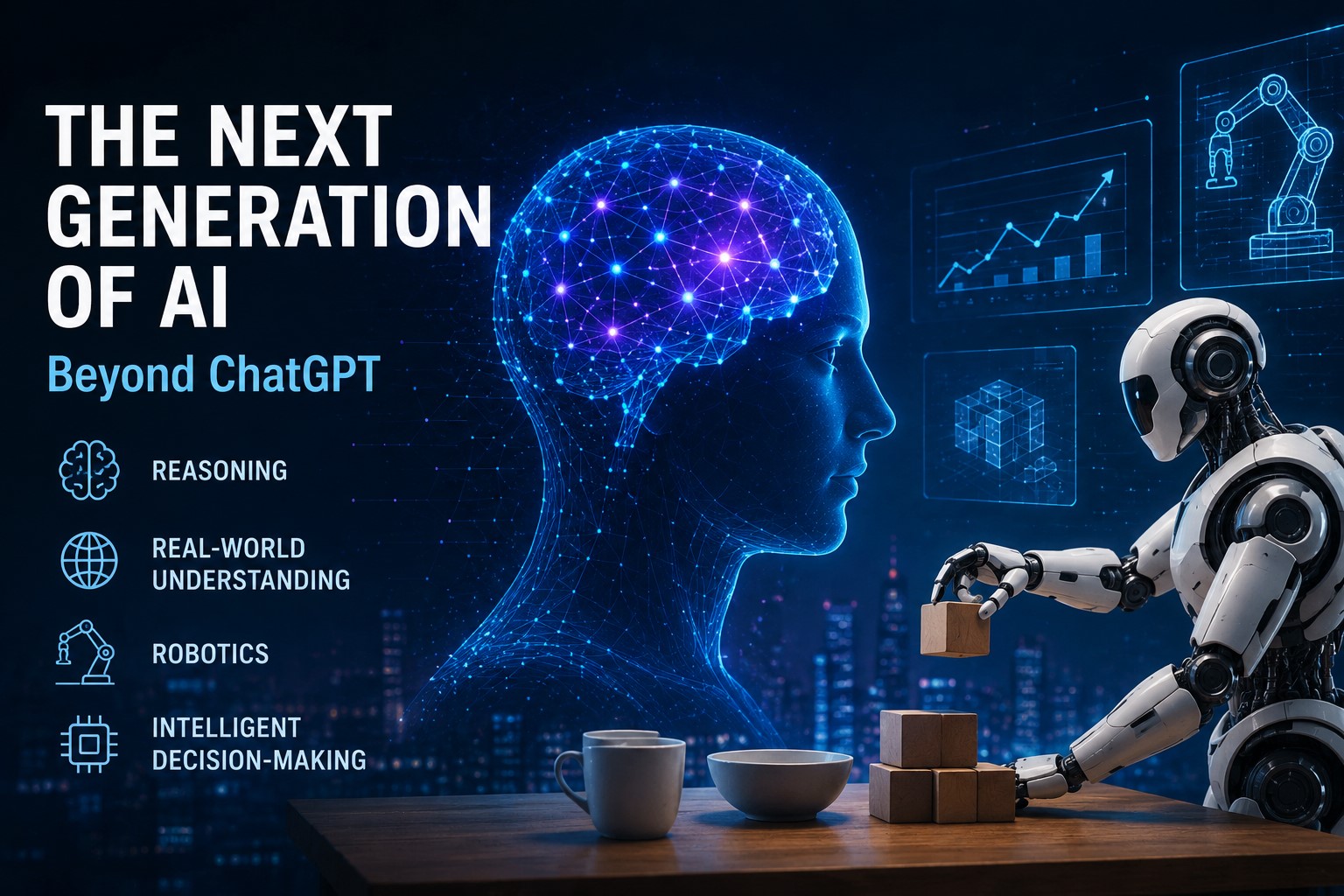
Artificial intelligence has made remarkable progress in recent years, with systems such as ChatGPT, Gemini, and Claude transforming how people work, learn, and create. However, many leading AI researchers believe these technologies represent only an early stage in the evolution of artificial intelligence.
Among those pushing for the next breakthrough is AI pioneer Yann LeCun, who argues that today's large language models (LLMs) excel at generating text and solving structured problems but lack a true understanding of how the physical world works. According to him, this limitation prevents current AI systems from performing complex real-world tasks such as safely operating household robots or making reliable decisions in unpredictable environments.
To overcome these challenges, researchers are developing a new generation of AI known as World Models or Joint Embedding Predictive Architecture (JEPA). Rather than relying solely on patterns learned from vast amounts of text, these systems are designed to build internal representations of the real world, allowing them to reason about actions, understand cause and effect, and predict multiple possible outcomes before acting.
The approach has attracted significant investor interest. New AI startups focused on advanced reasoning models have secured billions of dollars in funding from major technology companies and investment firms, reflecting growing confidence that the next wave of innovation will move beyond today's generative AI capabilities.
Experts say this research could play a crucial role in robotics, where machines must safely interact with constantly changing environments. Future AI systems may be capable of understanding physical objects, planning complex actions, and adapting to unexpected situations far more effectively than current language-based models.
Researchers at leading universities and technology companies are also pursuing similar ideas. Their goal is to create AI that not only generates information but also understands why events happen, explains its decisions, and evaluates different possible outcomes before taking action.
Although scientists acknowledge that building these advanced systems remains a major technical challenge, many believe progress could arrive faster than expected. The rapid emergence of generative AI over the past few years has demonstrated how quickly breakthroughs can reshape the industry.
If successful, next-generation AI could transform sectors including robotics, manufacturing, logistics, healthcare, autonomous transportation, and scientific research. Rather than replacing human creativity and judgment, researchers envision these systems acting as intelligent assistants—helping people solve increasingly complex problems while leaving strategic thinking, innovation, and decision-making firmly in human hands.
As artificial intelligence continues to evolve, the focus is gradually shifting from systems that simply generate answers to machines capable of understanding, reasoning, and interacting with the real world. That transition may define the next era of AI development.



Comments (0)
Sign in to join the conversation.