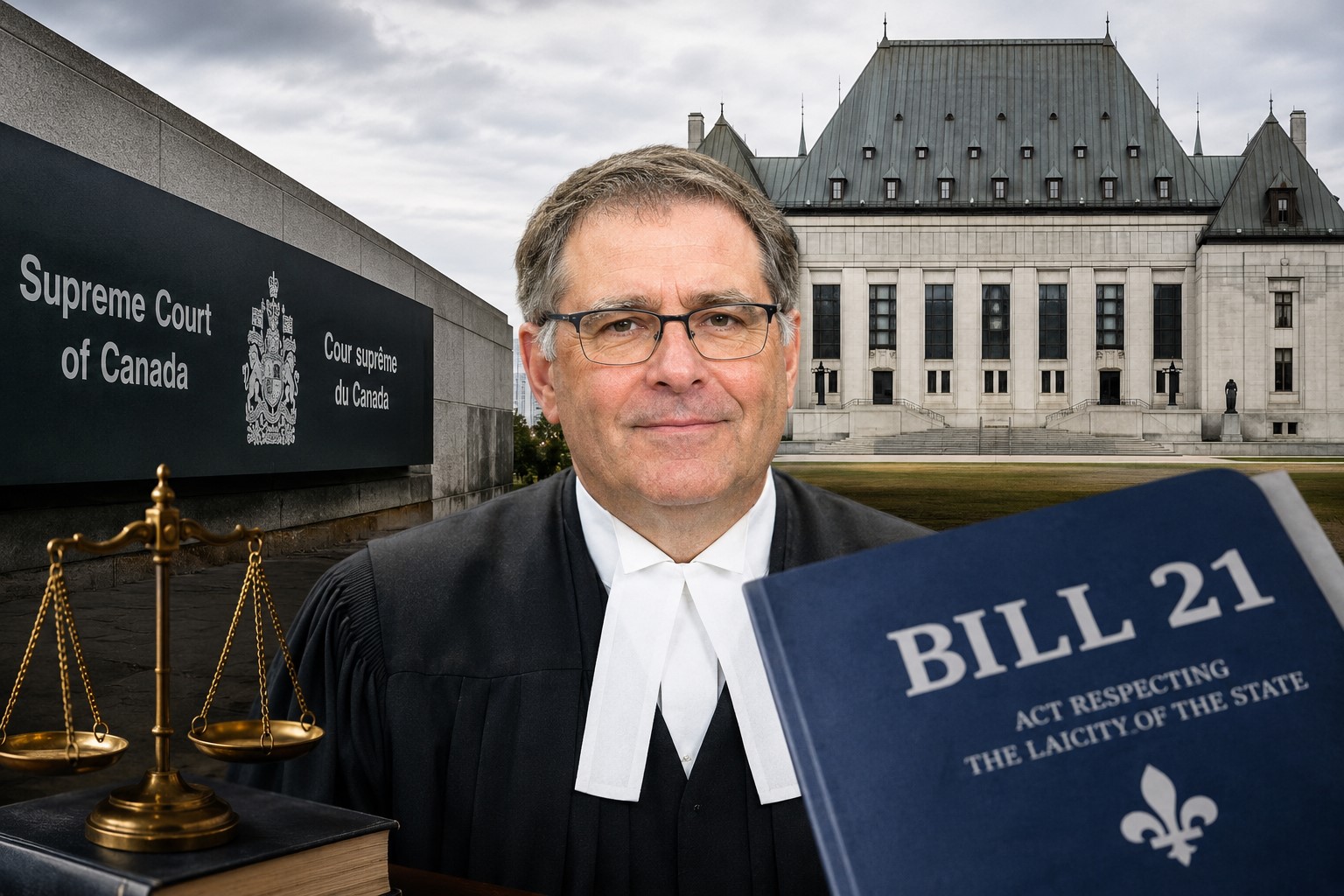
The Supreme Court of Canada is preparing to hear one of the most consequential constitutional cases in recent history as Chief Justice Richard Wagner leads the court's review of Quebec's controversial Bill 21. The ruling is expected to have far-reaching implications for religious freedom, constitutional rights and the balance of provincial authority across Canada.
Bill 21, formally known as the Act Respecting the Laicity of the State, prohibits many public-sector employees—including teachers, police officers and judges—from wearing visible religious symbols while performing their duties. Since its passage in 2019, the law has sparked widespread legal challenges and political debate, dividing public opinion across the country.
Supporters argue that the legislation reinforces the principle of state secularism and ensures government neutrality in public institutions. They contend that Quebec has the constitutional authority to define its approach to secularism and protect the separation of religion and the state.
Critics, however, say the law disproportionately affects religious minorities, particularly Muslim women who wear hijabs, as well as Sikh, Jewish and Christian public servants. Civil rights organizations argue that Bill 21 restricts freedom of religion, equality rights and employment opportunities, raising serious constitutional concerns.
The Supreme Court's decision will likely clarify how Canada's Charter of Rights and Freedoms interacts with the Constitution's notwithstanding clause, which allows governments to temporarily override certain Charter protections. Legal experts believe the judgment could establish important precedents for future constitutional disputes involving individual rights and provincial legislative powers.
Chief Justice Richard Wagner, who has served on Canada's highest court since 2012 and became Chief Justice in 2017, is expected to play a central role in guiding the court through one of the most closely watched legal cases in Canadian history. His leadership and the court's eventual ruling are likely to influence Canadian constitutional law for years to come.
Beyond Quebec, the decision may affect how provinces approach legislation involving religious expression, public sector employment and the limits of government authority. Political leaders, legal scholars and advocacy groups across Canada are closely monitoring the proceedings, recognizing that the outcome could redefine the relationship between individual freedoms and provincial autonomy.
As Canadians await the Supreme Court's judgment, the Bill 21 case stands as a defining moment for the country's legal system, testing the strength of constitutional protections while shaping the future interpretation of rights and freedoms in Canada.



Comments (0)
Sign in to join the conversation.